

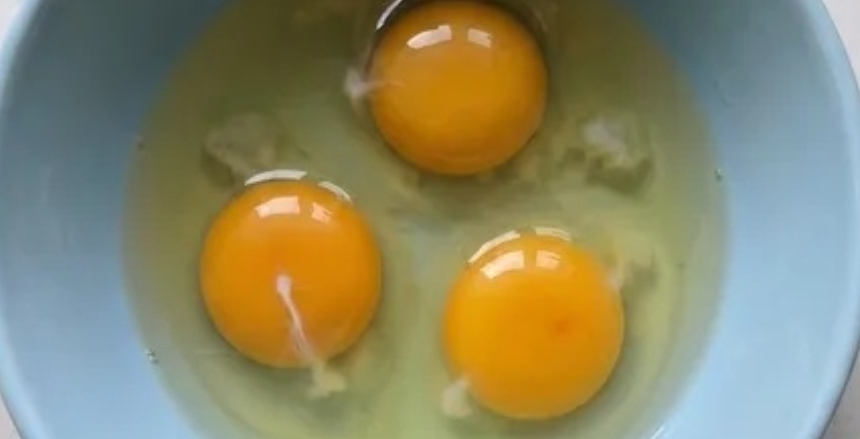
We’ve all been there: you’re ready to whip up a Sunday breakfast, you crack an egg into the bowl, and suddenly you see it—a weird, stringy white clump clinging to the yolk. If you aren’t familiar with egg anatomy, your first instinct might be to toss the whole carton in the bin.
But before you waste a perfectly good dozen, let’s clear the air (and the eggs). That “white stuff” isn’t a sign of spoilage; in fact, it’s exactly the opposite.
Meet the Chalaza
That opaque, rope-like string is called the chalaza (plural: chalazae). While it might look unappealing to some, it serves a vital purpose:
The Anchor: The chalaza acts like a tiny seatbelt or bungee cord. It’s a specialized form of protein that anchors the yolk in the center of the egg white (the albumen).
Protection: By keeping the yolk suspended in the middle, it prevents it from pressing against the shell, where it would be more vulnerable to bacteria.
Why You Should Actually Be Happy to See It
….
Please Head On keep on Reading (>)
Why You Should Actually Be Happy to See It
If you find a very prominent, thick chalaza, you should actually celebrate.
Prominent chalazae are a sign of extreme freshness. As an egg ages, these protein strands begin to break down and become transparent or disappear entirely. If you can see them clearly, that egg was likely laid very recently.
Does it Change the Taste?
Not at all. The chalaza is completely edible and has the same nutritional profile as the rest of the egg white. Once you cook the egg—whether you’re scrambling, poaching, or baking—the chalaza disappears into the rest of the white. You won’t feel a different texture, and you certainly won’t taste it.
Pro-Tip: The only time professional chefs remove them is when making ultra-smooth custards or curds, simply to ensure a perfectly uniform texture. For your morning omelet? Leave it be!
Summary: Keep or Toss?
If you’ve been arguing over whether to throw out your eggs because of these strings, here is the verdict:
White stringy bits? Fresh and safe.
Cloudy whites? Also a sign of freshness (carbon dioxide hasn’t escaped yet).
When to actually worry: If the egg has a distinct “rotten” sulfur smell, if the yolk is flat and breaks instantly, or if the white has a pinkish or iridescent hue (a sign of bacteria).
Next time the “white stuff” appears, put the trash lid down—dinner is served