

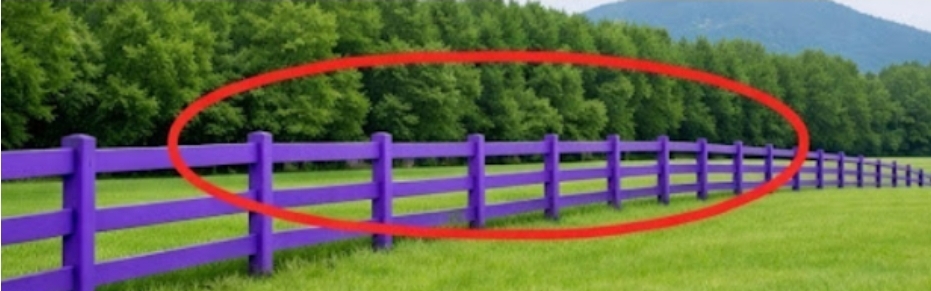
That bold stripe of purple paint on a fence post, tree trunk, or rock isn’t an artistic statement or a surveyor’s mark. In at least 22 U.S. states, it carries the full legal weight of a “No Trespassing” sign—no words required.
This is the Purple Paint Law, a practical and increasingly widespread solution designed to help landowners clearly mark property boundaries in remote, wooded, or rural areas where traditional signs may fade, rust, or disappear. For hikers, hunters, riders, and curious explorers, understanding this quiet signal is both a legal responsibility and a gesture of respect.
What the Purple Paint Law Means
In states that have adopted this statute, a vertical stripe of commercial-grade purple paint placed along a property line serves as legally enforceable notice that entry is prohibited. The law recognizes that in vast tracts of forest, farmland, or wilderness, posting individual signs at every boundary point is impractical. Purple paint offers a durable, highly visible, and cost-effective alternative.
States That Recognize Purple Paint as Legal Notice (as of 2026)
States That Recognize Purple Paint as Legal Notice (as of 2026)
While specific regulations vary by jurisdiction, the following states officially recognize purple paint as a valid trespass deterrent:
Alabama
Arizona
Arkansas
Florida
Georgia
Idaho
Illinois
Indiana
Kansas
Maine
Maryland
Missouri
Montana
North Carolina
Oregon
South Carolina
Tennessee
Texas
Utah
Virginia
West Virginia
Wyoming
Note: A small number of states, such as Colorado, permit alternative colors like orange for similar purposes. However, purple remains the most widely adopted standard nationwide.
Legal Requirements for Valid Markings
For purple paint markings to hold up in court, they generally must meet specific criteria established by state law. While details differ, common standards include:
Color: Commercial-grade purple paint—not chalk, spray paint, or temporary dye.
Placement: Applied to trees, fence posts, rocks, or other fixed objects along the property boundary.
Dimensions: Typically 8–10 inches in length and 1–2 inches in width.
Height: Positioned 3–5 feet above ground level to ensure visibility to pedestrians, riders, and drivers.
Spacing: No more than 100 feet apart in wooded areas; up to 1,000 feet in open terrain (exact requirements vary by state).
For example, Texas Penal Code §30.06 specifies that markings must be “readily visible to any person approaching the property.” Similar language appears in statutes across adopting states.
Why Purple?
The choice of purple is deliberate and strategic:
High visibility: Purple stands out against green foliage in summer, brown undergrowth in fall, and white snow in winter.
Distinctiveness: Rare in natural landscapes, purple is unlikely to be confused with environmental features or accidental marks.
No conflict with existing codes: Unlike red, orange, blue, or yellow—which are reserved for utility marking, surveying, or agricultural use—purple has no competing standardized meaning in rural land management.
Consequences of Ignoring the Markings
Trespassing on land marked with legally compliant purple paint can result in:
Fines ranging from $100 to $500 or more, depending on the state and circumstances
Criminal charges, typically classified as a misdemeanor
Confiscation of equipment (such as hunting gear) in certain jurisdictions
Civil liability if property damage, disturbance to livestock, or harm to protected habitats occurs
Importantly, claiming “I didn’t see the sign” or “I didn’t know” is rarely a successful legal defense. Courts in adopting states generally rule that properly applied purple paint constitutes reasonable, constructive notice of private property.
A Note on Mutual Respect
For landowners, purple paint is a quiet, dignified way to protect privacy, safeguard livestock and crops, preserve wildlife habitats, or manage recreational access without confrontation. It communicates boundaries clearly while minimizing visual clutter.
For visitors, it is an unambiguous signal: This space is cared for. Please honor its limits.
So the next time you encounter that bold purple stripe while walking a trail, riding a backroad, or exploring the countryside—pause. Recognize the intention behind it. And turn back with respect.
Because clear boundaries, honored by all, allow both private stewardship and public enjoyment of our shared landscapes to coexist.